Research data for "Investigation of sputtering and erosion phenomena in radio-frequency quadrupoles"
Creators

- 1.
 TU Wien
 - 2. European Spallation Source
- 3. National Technical University of Athens
- 4. Istituto Nazionale di Fisica Nucleare, Laboratori Nazionali di Legnaro
Description
Summary
This data repository contains the sputtering yield measurement data and atomic force microscopy (AFM) files used in the following publication:
Emmanouil Trachanas, Luca Bellan, Gyula Nagy, Antonio Palmieri, Andrea Bignami, Richard Arthur Wilhelm, Francesco Grespan, and Nikolaos Gazis, Phys. Rev. Accel. Beams 28, 104501 (2025).
Technical details
The raw measurement files presented here are all human-readable ASCII files.
For the sputter yield measurements, the files contain the term "QCM_data". These files contain the recorded quartz crystal microbalance (QCM) frequencies together with a time-stamp, in a 2-column format. Although within one such file there are recorded data for multiple incidence angles (for practical reasons, i.e. one file is one un-interrupted angle scan measurement), the file name itself indicates the order of the different angles. The 4 datasets represent 4 measurements using different beam energies and species, also indicated in the file name. An example is shown in Figure 5 of the published paper, with visual explanation of the data interpretation.
For calculating absolute sputter yields from QCM measurements, one needs the intensity of the incident beam, and the constants of the quartz crystal microbalance. Incident beam intensity is calculated from the beam profiles, found in the files starting with a name "BeamProfile" for each beam energy and species. For the 2 keV H+, 2 keV Ar+ and 36 keV Ar6+ irradiation, the average beam intensity was calculated from the profiles taken before and after. For the 6 keV H+, there are 5 more beam profiles recorded in addition to the before and after ones. These intermediate beam profiles were recorded evenly distributed during the whole measurement. The QCM constants used for the experiment can be found in the file "QCM_constants.txt".
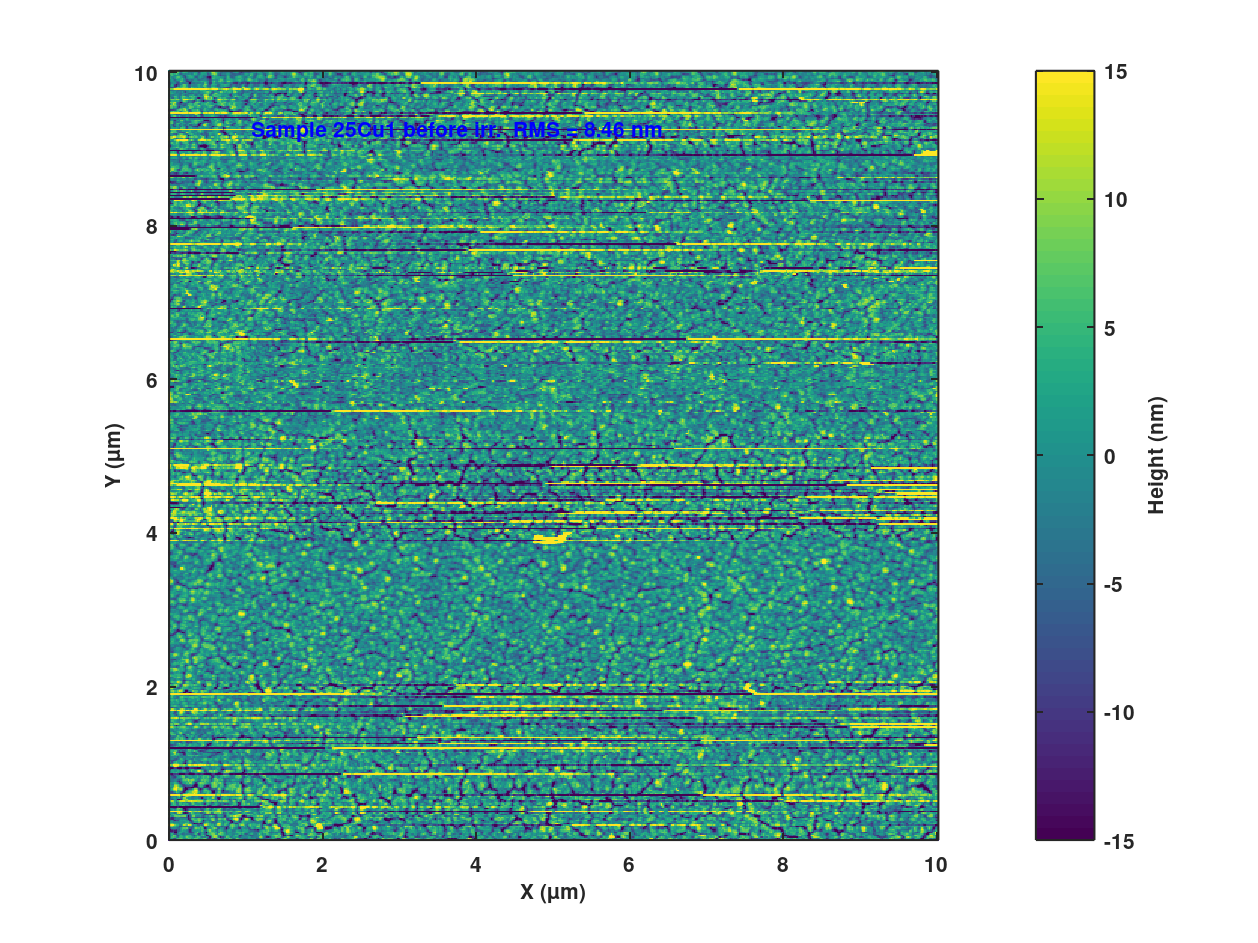
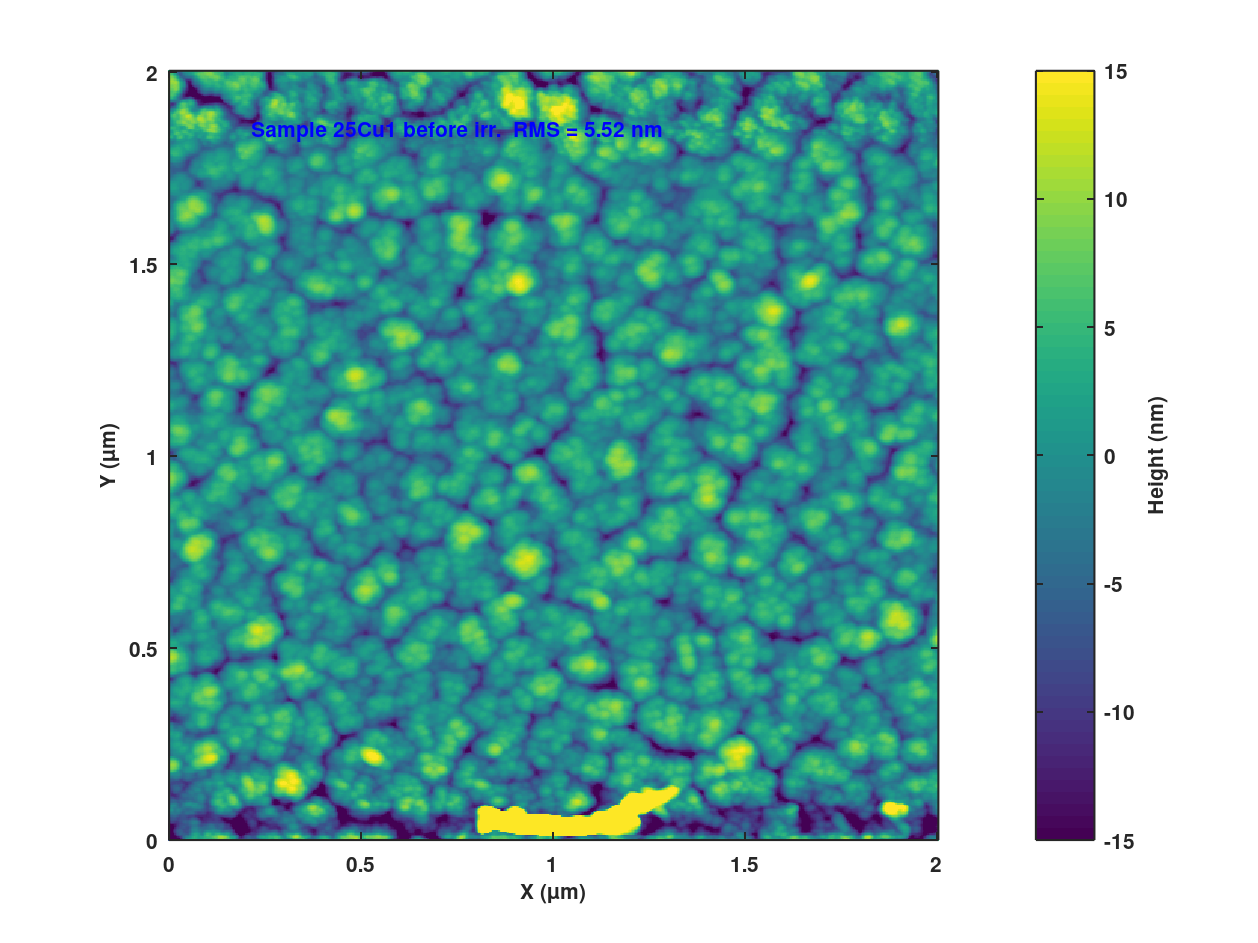
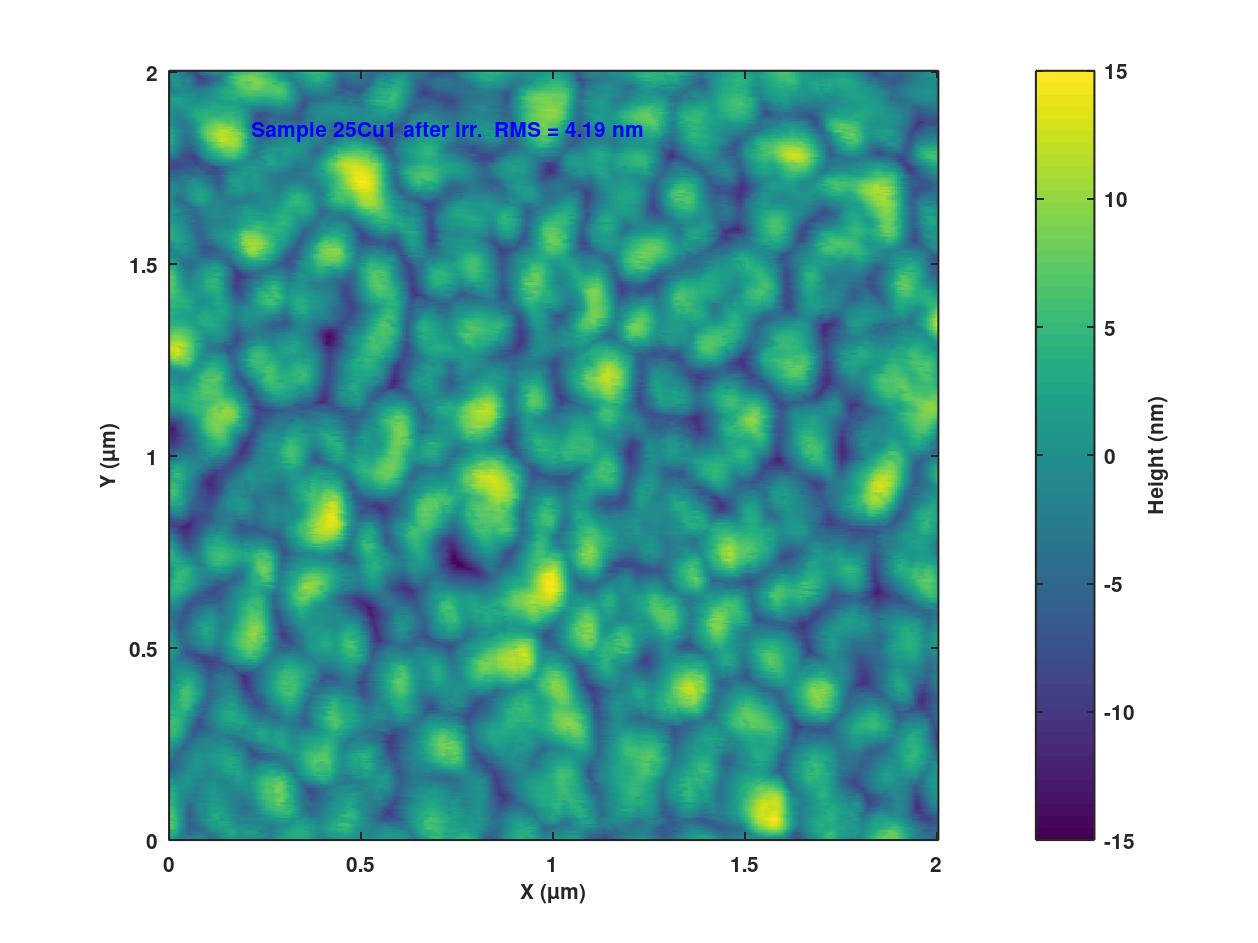
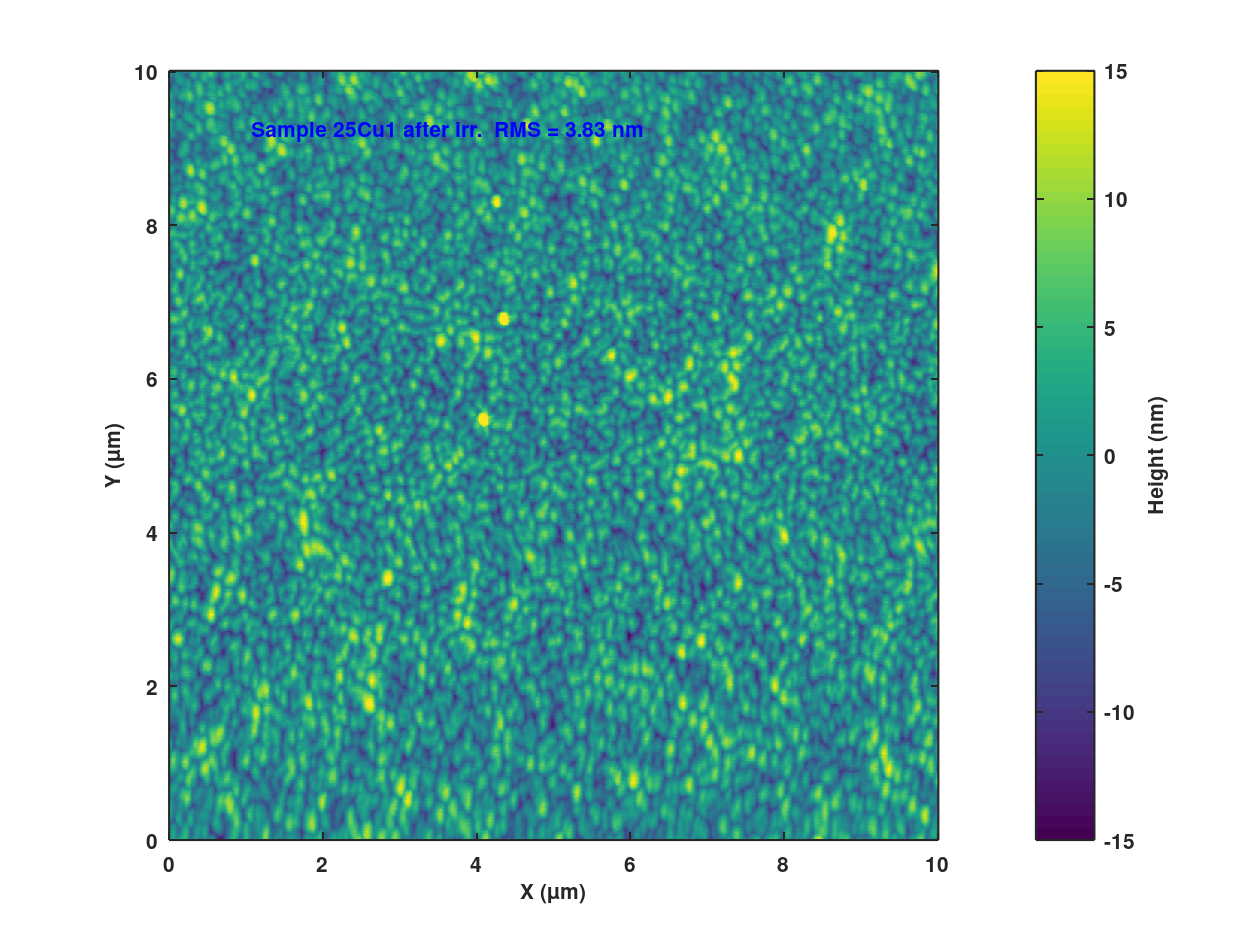
The files starting with "25Cu1" (which is the sample ID that is used for the study), are AFM data. For each AFM measurement, both the raw microscopy data file converted to a human-readable ASCII file, and a visual representation in png format are available. The ones containing the term "before" were taken before the sputter yield measurement, while those with the term "after" were taken after the ion irradiations.
Abstract (English)
The performance and stability of radio-frequency quadrupoles (RFQs) depend critically on the structural integrity of their electrodes (vanes or rods), which are subjected to high-intensity ion beam exposure during accelerator operation. This study investigates the sputtering induced vane erosion on the European Spallation Source (ESS) RFQ, a critical component of the ESS linear accelerator. Particle tracking simulations for the determination of RFQ beam loss profiles were coupled to sdtrimsp software (static-dynamic transport of ions in matter sequential-parallel processing) modeling to estimate the sputtering yield distribution and the resulting erosion rates under nominal operating conditions. Methodology validation and benchmarking was performed using quartz crystal microbalance (QCM) measurements employing proton (2, 6 keV) and argon (Ar⁺ 2 keV, Ar⁶⁺ 36 keV) ion beams with incident angles of 0°–70°. The QCM experiments were used to benchmark sdtrimsp software simulation parameters for the calculation of sputtering yields and total electrode erosion rates across the energy and angular ranges relevant to the ESS RFQ. The results and conclusions are extended to RFQs employed for heavy-ion acceleration providing insights into long-term stability and performance degradation. The results indicate that heavy-ion irradiation leads to significantly higher sputtering yields and erosion rates compared to protons. It is estimated that the increased erosion rates result in critical frequency perturbations in RFQ cavities especially in high current or cw configurations that need to be effectively compensated.
Files
25Cu1_10um_before.png
Files (36.4 MiB)
| Name | Size | |
|---|---|---|
| md5:a559bb25fa5629cc9eb0a9eebe349d07 | 900.2 KiB | Download |
| md5:693656ab7f6d83ab15647706456cf818 | 1.1 MiB | Download |
| md5:357e8c2f8153b348b82f68da7c26add6 | 892.3 KiB | Download |
| md5:2e573ed5dcd79266a051dd7e240938c6 | 3.2 MiB | Download |
| md5:dea5da215dd8732b934b9686aff3ef25 | 687.7 KiB | Preview Download |
| md5:c68649421bc64bbee4f344f267403c5d | 359.3 KiB | Preview Download |
| md5:45c0bf941b06a7d73b1b1aba4b5cbe14 | 11.4 MiB | Preview Download |
| md5:df124c26e0a1df8728131a92fba8ae8b | 2.8 MiB | Preview Download |
| md5:0ccbc12d73509ff0fdcfc09d05fefc2a | 276.4 KiB | Preview Download |
| md5:72f4c94ccdcb69208a78910051ffb49f | 11.4 MiB | Preview Download |
| md5:e997a2883c0d48c0280de38a0dc931b1 | 2.8 MiB | Preview Download |
| md5:60ebdcc98511e8cd1ee015bf1d2bd7dc | 679.3 KiB | Preview Download |
| md5:c086f7ecf2419fc7f67bad0200573d5a | 708 Bytes | Preview Download |
| md5:1703e48342a2cb4458044a4625099238 | 734 Bytes | Preview Download |
| md5:76d3ef8a420967172df678a6331080c1 | 737 Bytes | Preview Download |
| md5:c2599a2c670462a1e94785f9de556b20 | 732 Bytes | Preview Download |
| md5:a3924fe537c082e651014f6788d09cd4 | 636 Bytes | Preview Download |
| md5:263acfe235d10af9ab240ba959d80331 | 614 Bytes | Preview Download |
| md5:e9ca24c82ef156cb8390d9ccbadb652d | 562 Bytes | Preview Download |
| md5:43425d0c1cc383f60316be428819196c | 587 Bytes | Preview Download |
| md5:2a6c777e8ddee382f49cb8be51f12e0e | 606 Bytes | Preview Download |
| md5:b34e6eb54fe80967933be4653b889258 | 614 Bytes | Preview Download |
| md5:37be57b9ef274f8a2efd8b17c8d63274 | 600 Bytes | Preview Download |
| md5:48d943118d3e89ec77d0a6cdf7ca779f | 610 Bytes | Preview Download |
| md5:f5049bfd2190b791ba174185e68ed701 | 589 Bytes | Preview Download |
| md5:088a70d605e1288a7b6f4bbc92a7c8af | 189 Bytes | Preview Download |
Additional details
Related works
- Is part of
- Journal Article: 10.1103/fxry-781s (DOI)